

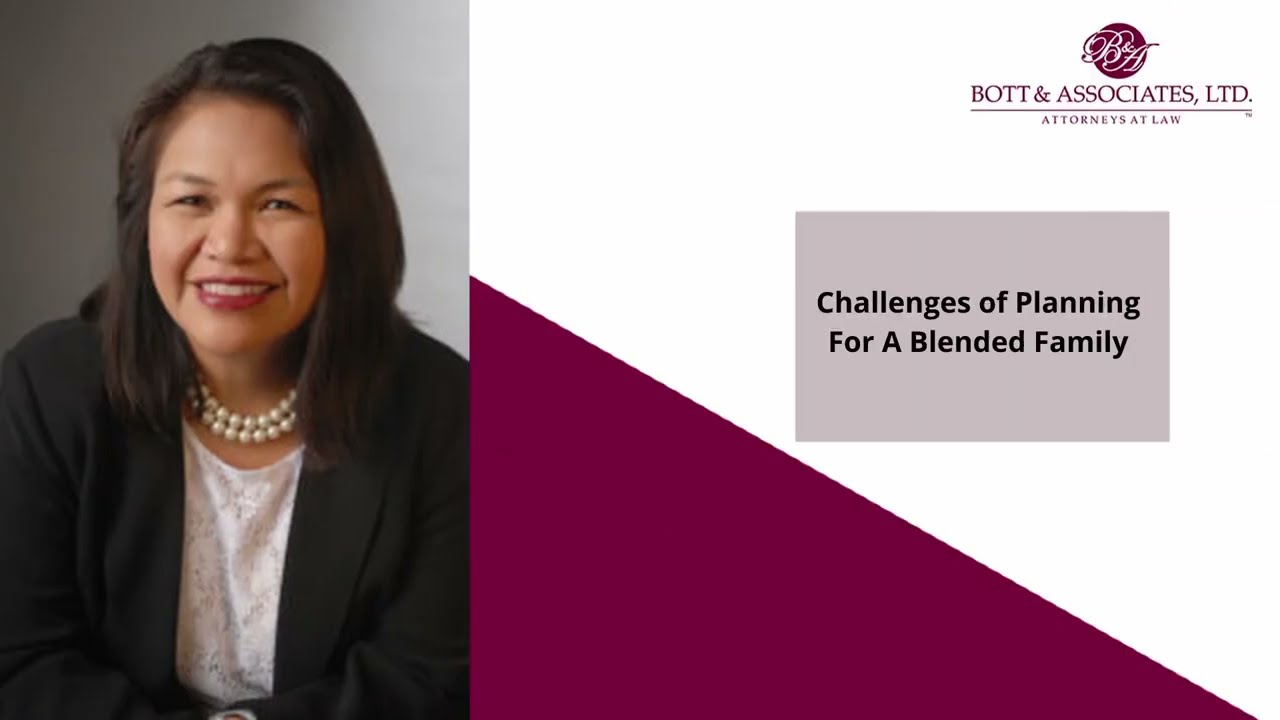
Speakers: Maritess Bott and Unidentified Off-camera Speaker
[Music]Off-camera Speaker:
Hey Maritess, I would love to hear some more about the challenges of planning for a blended family.
Maritess:
Yes. Estate planning is certainly already a challenging thing to think about because you’re always thinking about death and disability—not such a great topic. But when you do have a blended family, it’s even more important because the number one litigated issue is the estate of a blended family.
What do I mean by that? Well, statistics say that the divorce rate is over 50%. When people get divorced and then meet somebody else—who might be divorced as well or maybe a widow or widower—then they’re blending their families and trying to figure out who gets what upon the death of one person versus the death of the other person.
I always try to really think through it with them and have that conversation to figure out: if husband dies first, what happens, and then what happens upon the second death? Then we’ll reverse it, so that we can also think through what happens on the first death and make sure that everybody is still reasonably on good terms.
We can’t assure perfect relationships among the family members, but often we try to at least lessen the friction.
Let’s say you have partners who have children from previous marriages. They both come in with somewhat equal shares of assets, and they come in to see me and say, “We’ve been married five years, and now we want to take care of our estate.”
I ask, “Are you hoping to make sure the surviving spouse has full access to your assets before your children get the funds?”
Sometimes husband and wife, or partners, will say, “Yes, of course. We take care of each other first, and only when we both have gone will the children get the rest of the assets.”
That sounds perfectly fine—but it usually isn’t. Because what happens is, when the first person dies, the children on that decedent’s side are wondering, “Do I get anything from Dad’s estate? Do I get anything from Mom’s estate?” They might ask for some information. The surviving spouse could block them from getting access to anything in the house, which is really hurtful. The family is looking at it like, “What about Dad’s stuff that he had before he married you?” Or maybe heirlooms and pictures from Dad’s side of the family that really have nothing to do with this new wife or second spouse.
It’s often difficult for the family to accept that the surviving spouse will be fair and make sure that nothing’s changed in the documents—and that when he or she dies, they’re going to get a piece of whatever Dad’s inheritance was.
But it’s that timing. Nobody has a crystal ball. We have no idea when that timing will happen. One spouse can die, and it could be another 10 years before the second spouse dies. If there was no relationship during those 10 years, the family’s wondering, “What about me? Why didn’t I get anything?”
My concern and general recommendation for families like this—where they have a blended family—is: try really hard to give something to your children from your previous marriage. Do it up front. Maybe it’s life insurance. Maybe it’s a particular account. Or, 50% goes to my surviving spouse, the other 50% already goes to my children. That way, the relationship isn’t based on money or what happens upon the death of the second spouse. It’s just: Dad dies, you get this, and really, if they want to have a continuing relationship, they can. If not, they already know they’ve gotten a share from Dad’s estate. They don’t have to worry about the rest.
The second part of that is maybe having one of the kids be co-trustee with the surviving spouse. I say that so they don’t get locked out of the house—so they’re not told, “Don’t come here. We’re not giving you any pictures. We’re not giving you any of Dad’s memorabilia.” If one of the kids from Dad’s side is working together with the surviving spouse, and you’ve designated how much the kids are getting, and the surviving spouse gets something too, then you hope they’ll walk away, get their share, get their items, and not feel disinherited from Dad’s estate.
That’s one aspect of planning for children from a previous relationship. Because the surviving spouse—depending on what you do with your trust—can also make changes to that trust. The surviving spouse can say, “He’s gone. Now I’m going to give everything to my kids. Forget his kids.” All of a sudden, she gets all the memorabilia, all the assets in the house, the financial instruments, the house itself, and only her kids benefit.
That’s when it becomes really ugly. It can go to litigation. The family is heartbroken and frustrated because they didn’t get any say in Dad’s estate.
You could also tell me, “I don’t really care.” Certainly, it’s your money. It’s your assets. You could say, “I don’t care if my kids get anything or not. I’m going to benefit my spouse, and whoever she gives it to is fine.” If that’s your wish, I’m all for it. It is your decision. I’m not going to persuade anybody to do it differently. I’m just giving you the good, the bad, and the ugly—so you can make an informed decision.
That’s a typical scenario.
Now, another typical scenario that people may not think about is when a spouse coming into the marriage doesn’t have children. One spouse has children. The other has no kids. The spouse with no kids is very close to their nieces or nephews, or really likes their alma mater, or wants to give to some friends. It’s not just about giving everything to the surviving spouse.
When there are no kids on one side, then it’s even more important to say, “It’s my money. I’m going to decide, upon my death, to give some of it to the new spouse—but the rest is going to go to this charity, this friend, this niece, this nephew.”
Give that first—right at the top. Then the surviving spouse can go on with the amount you gave them. That way, the people you believe are important in your life can get their share without having to wait for the surviving spouse to pass away.
Also, prevent that from even being an issue. The surviving spouse might say, “I’m not going to give to that charity. It’s not my charity.” That would be prevented, because now, at the first death, the distribution is already made to those people.
The only way to assure that your wishes come true is to have a third-party trustee—either as co-trustee or sole trustee. Having a third party makes a huge difference. It eliminates emotion. It ensures everyone is on the same page: “I’m going to follow the rules of the trust—nothing more, nothing less.”
The family members don’t have to feel uncomfortable asking for documents, status, or when distributions will be made, because the third party is the buffer.
Whether you’re married for the first time, in a second marriage, or even in a cohabitation scenario where you’re not married but have been together for years—and you want to take care of each other and your children or beneficiaries—write it down. Get an estate plan done. Otherwise, the default is likely not going to be what you want.
If you don’t do a will, trust, or any planning, the default means more money to the government, more money to probate court, more money to lawyers going to court for you. And it could go inadvertently to people you never planned to benefit.
It’s important to get it all done. Write it down. Then we can talk through all the different scenarios and get your wishes down on paper.
We always recommend: every three years, let’s chat again. Let’s see if there are any updates or changes, because life happens—and maybe your preferred beneficiaries change. It’s always changeable—unless you become incapacitated, and certainly, upon death.
Again, this is Maritess Bott. Hopefully, you learned a little something. If you have questions, give us a call. We’ll be happy to help you out.
Thanks.
[Music]